TV advertising costs in 2026 run from a few hundred dollars for a local spot to more than $10 million for 30 seconds of the Super Bowl.
Key Highlights
- Streaming cost per thousand impressions (CPM) is averaging around $26 to $27, and connected TV (CTV) pricing kept falling through mid-2026
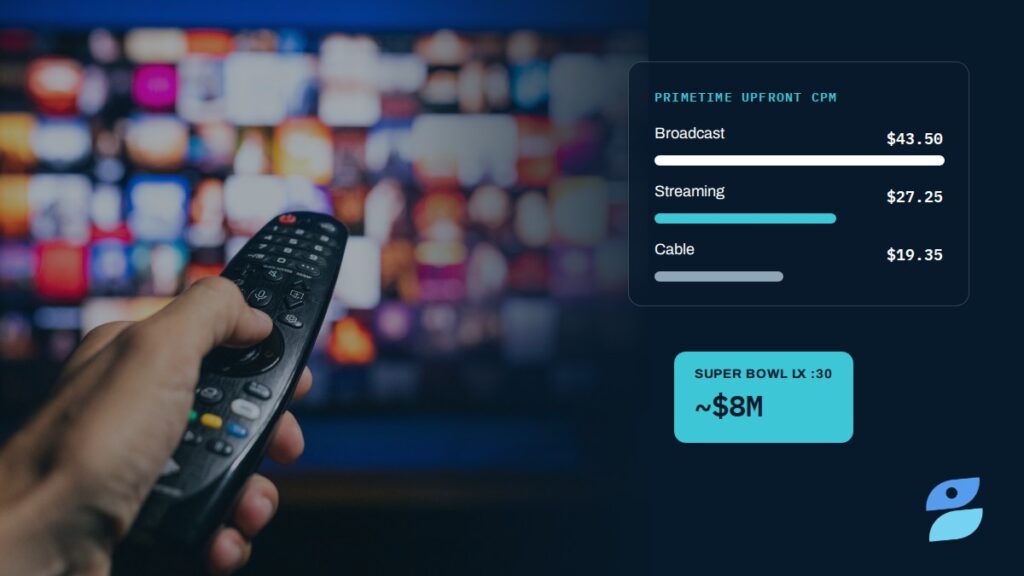
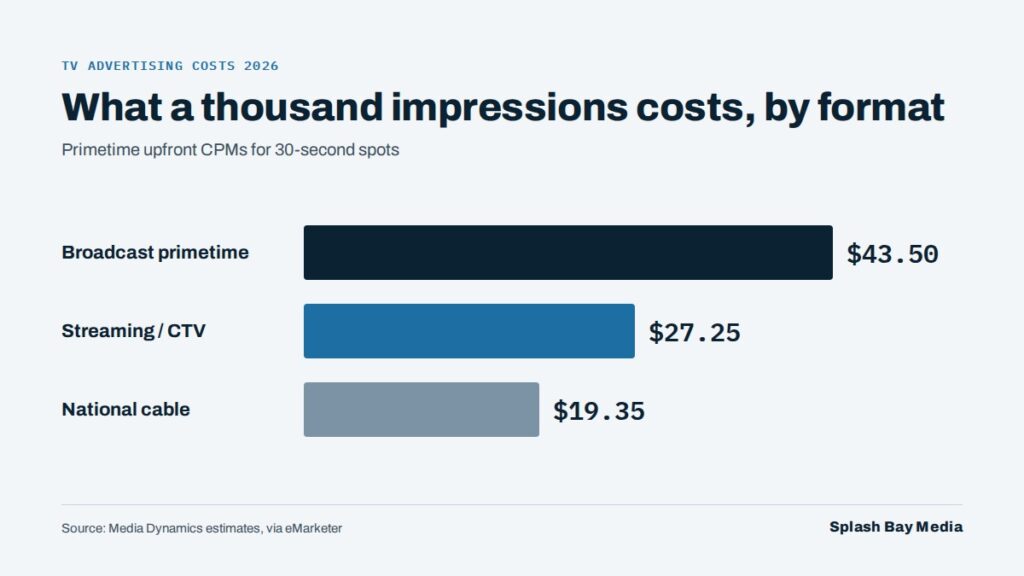
- Primetime upfront CPMs sit near $43.50 for broadcast, $19.35 for cable, and $27.25 for streaming
- Live sports is the exception: NFL primetime and the Super Bowl keep setting price records
- 2026 is on track to be the most expensive political ad cycle ever, which tightens local TV inventory through November
- The CPM you pay isn’t the CPM you get, because supply path fees and low-quality impressions quietly inflate your true cost
Below, we break down what each TV format actually costs in 2026, what moves the price, and where budgets leak.
TV Advertising Costs at a Glance: 2026 Benchmarks
No single number answers the question, because TV pricing depends on the screen, the market, and how you buy.
Linear TV still trades mostly on spot rates and gross rating points (GRPs), while streaming trades on CPM. Converting everything to CPM is the cleanest way to compare formats side by side.
| Format | 2026 benchmark | How it’s priced |
|---|---|---|
| National broadcast primetime | About $43.50 CPM (upfront) | Upfront or scatter, per :30 |
| National cable | About $19.35 CPM (upfront) | Upfront or scatter, per :30 |
| Streaming / CTV | About $26 to $27 CPM | CPM, via direct deals or programmatic |
| NFL primetime | About $560,000 to $1M+ per :30 | Per spot |
| Super Bowl LX | About $8M average per :30, $10M+ for some | Per spot |
| Local broadcast | Varies widely by market and daypart | Per spot or cost per point |
Upfront CPMs come from Media Dynamics estimates reported by eMarketer, based on last year’s upfront market. The streaming benchmark reflects eMarketer’s streaming CPM forecast. Per-spot figures come from Ad Age and NBCUniversal reporting, covered below.
Treat these as reference points, not rate cards. Your final TV advertising rates move with audience, targeting, flight timing, and supply path.
How Much Does a TV Commercial Cost? Airtime vs. Production
Every TV budget has two separate line items: the media you buy and the creative you run.
- Airtime: what you pay a network, station, or streaming publisher to run the spot. This is the number that scales with reach, and it’s what the rest of this guide covers.
- Production: what it costs to make the spot. Scope drives this line far more than runtime does, so a single-location shoot is a very different project from a multi-day shoot with union talent and licensed music.
CTV has changed production budgets in three ways:
- Streaming rewards versioning, so budgets now cover :15 and :06 cutdowns plus multiple creatives for rotation
- Frequency is harder to control across streaming publishers, which makes creative fatigue a real cost
- Talent usage rights and music licenses often need renegotiating when a linear spot moves to streaming
For the buying process itself, from planning to trafficking, see our guide on how to buy television advertising.
National Broadcast TV Advertising Rates
National broadcast remains the most expensive way to buy mass reach on TV, but most of its pricing is softening.
Media Dynamics estimates primetime broadcast upfront CPMs for :30s dropped 4.1% to $43.50. Broadcast primetime upfront sales also fell 2.5% to $9.1 billion.
Per-spot pricing shows where the premium really sits. In Ad Age’s 2024-25 primetime pricing survey, ad costs fell for 33 of 53 returning series, while football claimed the top three spots:
- Sunday Night Football (NBC): $1,008,746 per :30
- Monday Night Football (ABC): $637,718 per :30
- Thursday Night Football (Prime Video): $562,918 per :30
The fourth-priciest show, American Idol, came in at $131,943. That gap tells the whole story: live sports is priced as a scarce asset, and nearly everything else is priced against streaming.
Timing matters too. Upfront commitments lock in pricing and inventory before the season starts. Scatter buys happen closer to air and float with demand, so they can land above or below upfront rates.
Cable TV Advertising Costs
National cable offers the lowest linear CPMs, but you’re paying for an audience that shrinks every year.
Media Dynamics puts cable upfront CPMs at $19.35, down 6.8%, with cable primetime upfront sales slipping 4.3% to $8.7 billion.
Cable buys generally fall into three buckets:
- National cable: network-level buys priced by demo and daypart, with sports and news networks at the top of the range
- Local cable: zone or interconnect buys through a cable operator’s ad sales arm, useful for geography without buying a full market
- Addressable linear: household-level targeting on set-top box inventory, sold at a CPM premium over standard cable
The catch is cord cutting. As fewer households sit behind a cable box, the same CPM buys reach that skews older and overlaps more with your broadcast buy. Our comparison of OTT vs. CTV explains where those viewers went.
Local TV Advertising Costs by Market
Local TV advertising costs hinge on three variables: market size, daypart, and time of year.
Nielsen divides the U.S. into 210 designated market areas (DMAs), and price climbs with market rank. Published buying guides put a primetime :30 at a few hundred dollars in small markets and $5,000 to $50,000 or more in top-10 markets like New York, Los Angeles, and Chicago.
- Daypart: primetime and local news carry the highest rates, while daytime, early morning, and overnight cost less and reach fewer viewers
- Seasonality: Q4 retail demand and election years push local rates up, sometimes sharply
Stations quote either a per-spot rate or a cost per point (CPP), the price of reaching 1% of your target demo in the DMA. Convert both to CPM before comparing local linear against streaming.
That comparison is why local CTV keeps taking share. Streaming can target a DMA or ZIP code set and is bought on delivered impressions, so you pay for households reached instead of estimated ratings.
CTV Advertising Cost: What Streaming CPMs Look Like in 2026
CTV advertising cost has moved in one direction for two straight years: down.
eMarketer expected streaming CPMs to average about $26 to $27, as surging supply narrows the gap between premium and cheaper inventory. That trend held. DataBeat’s June 2026 programmatic data shows CTV pricing down 12.3% year over year, even as overall programmatic CPMs rose 51%.
Supply is the driver. Prime Video’s move to auto-enroll viewers into an ad tier flooded the market with impressions and pulled prices down across streaming. Growing ad tiers and free ad-supported streaming TV (FAST) channels added even more.
Price still varies by inventory type:
- Premium streaming direct: the highest CPMs, sold through direct insertion orders or programmatic guaranteed deals
- FAST channels: lower CPMs and massive scale, with more variance in content quality
- Open exchange CTV: cheapest on paper, with the most exposure to spoofed devices and low-quality apps
- Curated private marketplace (PMP) deals: priced between the two, packaged around specific audiences, content, and quality controls
Budgets are following the price. eMarketer projects 2026 CTV upfront spending of $17.73 billion, passing primetime linear’s $16.98 billion for the first time. For a platform-by-platform view, see our roundup of the best CTV advertising platforms.
Live Sports and Super Bowl Commercial Costs
Live sports is the one corner of TV where prices keep climbing.
Super Bowl ad pricing reached an average of about $8 million per :30, nearly double the $4.3 million average from 2015. NBCUniversal also sold a handful of Super Bowl LX spots for over $10 million, a record for the broadcaster.
The logic is simple. Live sports delivers simultaneous reach, low ad skipping, and cultural moments that on-demand viewing can’t replicate. The same scarcity keeps NFL primetime above $500,000 per :30 while other primetime shows get cheaper.
What’s changed is where sports lives. NBCUniversal sold its Super Bowl LX inventory across NBC, Peacock, and Telemundo, and Thursday Night Football runs on Prime Video. That opens a second route to sports audiences: programmatic CTV around live events, bought on CPM instead of a national per-spot rate.
Our Ichiro platform packages live sports inventory for exactly this use case, so buyers can reach fans across game windows without a tentpole-sized commitment.
Why TV Advertising Costs Spike in Election Years
2026 is a midterm year, and that affects every advertiser buying local TV this fall.
AdImpact now projects $11.6 billion in 2026 political ad spending, up from its original $10.8 billion estimate and above the $11.2 billion spent in the 2024 presidential cycle. The updated forecast puts broadcast at $5.6 billion, CTV at $2.7 billion, and cable at about $1.4 billion.
For commercial advertisers, that demand shows up in three ways:
- Tighter inventory: political buyers crowd local news and primetime, especially in battleground DMAs
- Preemption risk: stations can bump lower-priced commercial spots when political demand spikes
- Rising streaming rates: political CTV spend concentrates in the same contested markets, tightening local CTV supply too
Federal candidates are entitled to a station’s lowest unit rate in the 45 days before a primary and the 60 days before a general election. PACs and issue groups don’t get that protection, so they pay market rates, which pushes prices higher. For the buy-side playbook, read our political advertising guide for 2026.
The Hidden Cost: What Your Supply Path Takes
The CPM on your insertion order isn’t what you actually pay for a quality impression.
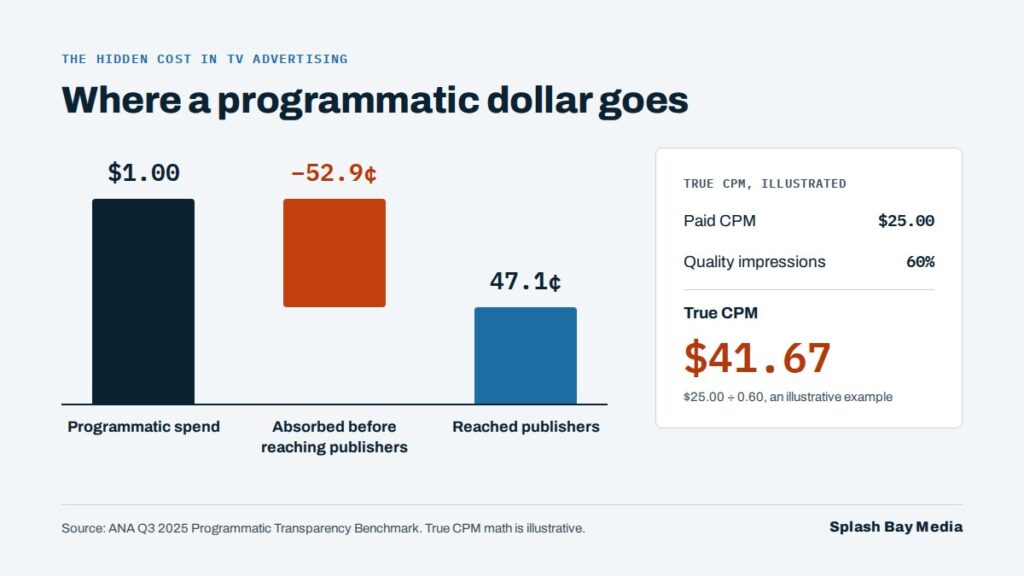
In programmatic TV buying, each dollar passes through demand-side platform (DSP) fees, supply-side platform (SSP) take rates, data costs, and sometimes reseller hops. The ANA’s Q3 2025 Programmatic Transparency Benchmark found that 47.1% of ad spend reached publishers, an 11-point gain since 2023. That’s progress, but it still means more than half of the budget was absorbed along the way.
CTV adds its own leakage:
- Device and app spoofing: fraudulent traffic that mimics premium streaming apps
- Duplicate supply paths: the same impression offered through multiple resellers, which inflates auction pressure and clearing prices
- Opaque packaging: bundled inventory with no app- or show-level transparency
The metric that matters is true CPM: total spend divided by the impressions that actually meet your quality bar. Here’s the math. If you pay a $25 CPM and only 60% of impressions are fraud-free and on the apps you intended, your true CPM is about $41.67.
Our supply path optimization guide covers how traders cut those hops.
How to Lower Your Effective TV Advertising Costs
You can’t negotiate the Super Bowl down, but you can control what you pay per quality impression everywhere else.
- Buy curated PMPs over open exchange: private marketplaces made up 81.6% of spend in the ANA benchmark, which shows where quality-focused buyers are moving
- Consolidate supply paths: fewer, cleaner routes to the same inventory mean less duplication and fewer fees
- Use bid enrichment: audience and contextual signals attached on the sell side let you price impressions on value, not guesswork
- Set goals before you buy: CPM only means something against a defined outcome, and our CTV goal-setting best practices break this down
- Measure on outcomes: judge TV on incremental reach, site visits, or conversions, not impressions alone
This is the problem we built our Ichiro curation platform to solve. Ichiro is SSP-agnostic, so we curate CTV inventory across supply sources instead of routing everything through one exchange. We layer in bid enrichment, package live sports and political inventory, and deliver curated deals into the DSP your team already uses.
The Bottom Line
TV advertising costs in 2026 depend less on the channel you pick and more on how efficiently you buy it.
Broadcast and cable CPMs are softening, CTV is cheaper than it’s been in years, and live sports keeps setting records. Local TV will stay volatile through November as midterm spending peaks.
The biggest cost lever isn’t the rate card. It’s the gap between the CPM you pay and the quality impressions you actually get. Close that gap with curated supply, cleaner paths, and outcome-based measurement, and your TV budget goes further on every screen.
Want to see what curated CTV inventory would cost for your next flight? Book a meeting with our team or learn about Ichiro.
Frequently Asked Questions
How much does a 30-second TV commercial cost in 2026?
A 30-second TV commercial costs anywhere from a few hundred dollars for a local daytime spot to about $8 million for an average Super Bowl LX placement. National primetime football runs roughly $560,000 to over $1 million per spot, while most non-sports primetime shows cost far less. Production is a separate budget line on top of airtime.
What is the average CTV advertising cost?
Streaming CPMs are averaging around $26 to $27, according to eMarketer, and CTV prices fell further through mid-2026 as ad supply grew. Your actual cost depends on inventory type. Premium direct deals cost the most, open exchange costs the least on paper, and curated PMP deals sit in between with stronger quality controls.
How much does a Super Bowl commercial cost?
A 30-second Super Bowl LX commercial averaged about $8 million in 2026, and NBCUniversal sold a few spots for more than $10 million. That price covers airtime only. Brands also pay for production, talent, and promotion before and after the game, which can push total campaign investment well past the media buy.
Is local TV advertising cheaper than streaming?
It depends on how you measure. A local broadcast spot can cost less per airing, but you’re paying for estimated ratings across an entire DMA. Local CTV is bought on delivered impressions and can target specific ZIP codes or audiences. Once you convert both to CPM and factor in waste, streaming often wins for targeted campaigns, while broadcast still leads on raw local reach.
Why do TV advertising rates go up in election years?
Political advertisers compete for the same local inventory as brands, especially in battleground markets. AdImpact projects a record $11.6 billion in 2026 political ad spending. Federal candidates get the lowest unit rate close to elections, but PACs and issue groups pay market rates, which tightens supply and raises prices for commercial advertisers through Election Day.