Every CTV buy you make traces back to one question: how does the platform on the other end make its money?
Key Highlights
- AVOD, SVOD, TVOD, FAST and BVOD are monetization models, not content categories, and each one produces a different kind of ad inventory.
- AVOD delivers on-demand library content with impression-level ad decisioning, which is why most addressable CTV supply originates there.
- FAST runs on a fixed channel schedule, so it behaves like linear TV while clearing through programmatic pipes.
- TVOD is the only model in the group that generates no in-stream ad inventory at all.
- Nearly every major streamer now runs two or more models at once, so the acronym on the platform tells you almost nothing about the impression you are actually buying.
The distinctions below matter less as taxonomy and more as a read on what lands in your bidstream.
What AVOD Means and Why Buyers Start There
AVOD stands for advertising-based video on demand.
Viewers pick a title from a library and watch it free, or at a discount, and advertising covers the cost. Tubi, Pluto TV and The Roku Channel are the familiar US examples, but the model also sits underneath most ad tiers on subscription services.
The reason AVOD anchors so much CTV planning is structural. On-demand playback means every session is ad-served individually, so you get decisioning at the impression rather than against a schedule. That is where audience targeting, frequency management and deal-level control actually work.
Ad loads run light compared with linear, usually four to six minutes per hour, and often less on premium tiers. Lower load means less clutter, but it also means finite inventory in the highest-demand content.
The catch: AVOD libraries lean heavily on licensed catalog and long-tail content. Without content-level transparency, a strong CPM can still buy you a poorly matched environment.
How SVOD Changed Once Ad Tiers Arrived
SVOD is subscription video on demand, where viewers pay a recurring fee for access.
For a decade this model was closed to advertisers by design. That ended fast. Netflix, Disney+, Max, Paramount+ and Prime Video now all run ad-supported tiers, and the ad tier is frequently the default signup path.
The scale is no longer marginal. At its 2026 upfront presentation, Netflix said its ad tier now reaches more than 250 million monthly active viewers worldwide, with over 80% of ad plan members watching every week.
For traders, SVOD ad tiers behave differently from classic AVOD. Content is premium and originals-heavy, ad loads are deliberately tight, and demand outpaces supply. So expect higher CPMs, meaningful reach against cord-cutters, and stricter controls on how you can buy.
What to watch: many SVOD ad tiers still gate substantial inventory behind direct or platform-preferred paths, which shortens your effective supply options.
Where TVOD Fits, and Why It Has No Ad Inventory
TVOD is transactional video on demand, and it is the outlier in this group.
Viewers rent or buy individual titles through storefronts like Apple TV, the Prime Video store or Fandango at Home. Because the transaction covers the content, no ads run inside the stream. There is nothing here to bid on.
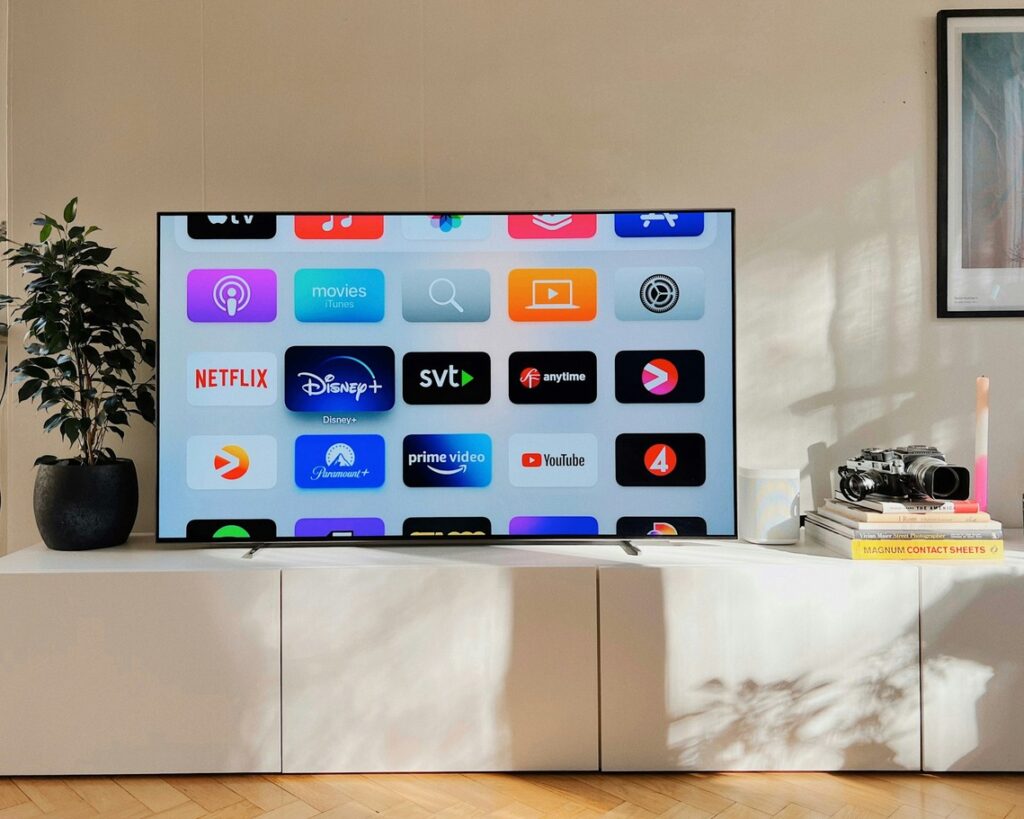
TVOD still matters to your planning for two reasons. It competes directly for premium attention in the household, and the storefronts themselves sit inside ad-supported operating systems. Home screen and marquee placements on Roku or Fire TV are media, even when the title behind them is not.
If a partner presents TVOD as part of a CTV inventory package, ask exactly which placements are being sold.
How FAST Channels Differ From AVOD
FAST stands for free ad-supported streaming television, and the defining feature is the schedule.
Instead of choosing a title, the viewer picks a channel and joins a programmed stream already in progress. Pluto TV, Samsung TV Plus, Tubi’s live channels and The Roku Channel all operate this way. The experience is linear, but the delivery, targeting and ad insertion are entirely digital.
That combination has produced real audience share. In Nielsen’s January 2026 Gauge report, Tubi rose 6% month over month to 2.1% of total TV, while The Roku Channel gained 5% and held a platform-best 3.0% share for a second straight month.
Why FAST is attractive: volume is enormous, CPMs run well below premium SVOD, and channel-level context is unusually clean. A true crime channel, a news channel or a live sports channel tells you more about the audience than a genre tag on a VOD library does.
Why FAST needs scrutiny: the same channel is often resold through multiple SSPs, and long-tail channels can pad a package with inventory nobody is really watching. Duplication and thin channels are the two failure modes worth screening for.
What BVOD Adds to the Mix
BVOD is broadcaster video on demand, the on-demand arm of a traditional broadcaster.
Peacock, Hulu’s next-day network episodes and international equivalents like ITVX all fall here. The content is professionally produced, rights-cleared and originally made for broadcast, which makes it the most predictable brand-safety profile in streaming.
BVOD also carries the strongest co-viewing characteristics, because the content still draws family and household audiences. Many BVOD platforms bundle live simulcasts, news and sports alongside catch-up episodes.
The tradeoff is familiar: quality commands price, and inventory is finite.
Hybrid Models Are Now the Default
Almost no major streamer runs a single model anymore.
Prime Video sells subscriptions, serves ads by default, operates a rental storefront and carries FAST channels, all inside one app. Peacock and Paramount+ layer ad-supported and ad-free tiers over live sports and catch-up broadcast content. Tubi mixes on-demand library titles with scheduled channels.
The result is that the label on the platform no longer describes the impression. Nielsen’s Q1 2026 Ad Supported Gauge found ad-supported viewing holding steady at close to 73% of all TV viewing, spread across every one of these models at once.
That is why model-level buying breaks down in practice. You have to buy at the inventory level instead.
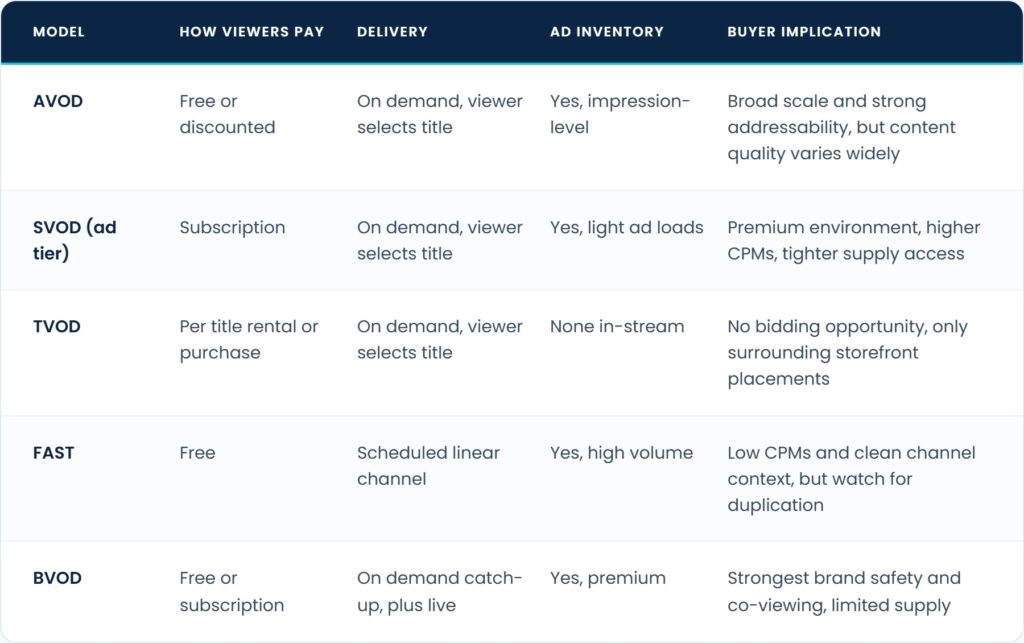
AVOD vs SVOD vs TVOD vs FAST vs BVOD at a Glance
What Each Model Means for Your Inventory
The practical question is not which model is best, but what each one changes about the impressions you win.
Scale: FAST and AVOD supply the bulk of available CTV impressions. If your campaign needs efficient reach, that is where the volume sits.
CPM range: premium SVOD ad tiers and BVOD sit at the top, AVOD in the middle, FAST at the bottom. Sports and news carry a premium across every model.
Content transparency: on-demand libraries can hide long-tail titles behind aggregate app names. Channel-level FAST inventory is often easier to inspect than app-level AVOD inventory.
Frequency control: on-demand models handle frequency capping more cleanly than scheduled FAST streams, where SSAI stitching and multiple supply paths make dedupe harder.
Supply path: the same impression frequently appears through several SSPs at different clearing prices. Model type has no bearing on this. Path selection does.
That last point is where most CTV waste actually lives, and it is the reason supply path optimization belongs in the conversation before model selection does.
How We Approach Buying Across Models
Sorting inventory by acronym is a planning exercise, not an activation strategy.
Our Ichiro curation platform is built to package supply across AVOD, FAST, BVOD and SVOD ad tiers into curated PMPs that resolve into a single Deal ID in your DSP. Because we are SSP agnostic, we select the path to each publisher rather than defaulting to whichever exchange sold us first.
That matters most in the places where model boundaries blur. Live sports runs across FAST channels, BVOD simulcasts and SVOD tiers simultaneously, and political inventory demands verified content-level control that app-name reporting cannot provide.
If you want the wider picture on how this supply fits together, our guide to connected TV advertising covers the buying landscape end to end.
The Bottom Line
AVOD, SVOD, TVOD, FAST and BVOD describe how a platform earns revenue, and each one produces inventory with a distinct scale, price and transparency profile.
AVOD gives you addressable on-demand impressions at scale. FAST gives you volume and channel-level context at low cost. BVOD and SVOD ad tiers give you premium environments at premium prices. TVOD gives you nothing to buy in-stream.
But the models have collapsed into each other. Streaming reached 48.6% of total TV watch-time in May 2026, according to Nielsen’s May 2026 Gauge report, and most of that viewing now happens on platforms running multiple models at once.
The buyers who win in this environment stopped sorting by acronym and started curating at the inventory level. That is the approach behind our no B.S. philosophy, and it is the fastest way to stop paying premium rates for supply you never inspected.
Ready to see what curated CTV supply looks like across every one of these models? Book a meeting with our team.
Frequently Asked Questions
What is AVOD?
AVOD stands for advertising-based video on demand. Viewers access a library of on-demand content for free or at a reduced subscription price, and advertising covers the cost. Tubi, Pluto TV and The Roku Channel are common examples. For advertisers, AVOD produces impression-level addressable inventory, which makes it a primary source of targetable CTV supply.
What is the difference between AVOD and SVOD?
AVOD is free or low-cost and funded by advertising, while SVOD is funded by subscription fees. The line has blurred because nearly every major SVOD service now offers an ad-supported tier. The practical difference for buyers is inventory character: SVOD ad tiers carry premium originals with light ad loads and higher CPMs, while pure AVOD offers broader library content at greater scale.
What does FAST channel mean?
FAST means free ad-supported streaming television. A FAST channel runs a fixed programming schedule delivered over the internet, so viewers join a stream in progress rather than selecting a title. Pluto TV and Samsung TV Plus are the reference platforms. Ads are inserted server-side, which gives you digital targeting inside a linear viewing experience.
Is BVOD the same as AVOD?
No. BVOD is broadcaster video on demand, meaning on-demand access to content produced by traditional broadcasters, usually catch-up episodes and live simulcasts. AVOD is a broader category covering any ad-funded on-demand library. BVOD inventory is typically more expensive, more brand-safe and more limited in volume, because it is tied to professionally produced broadcast programming.