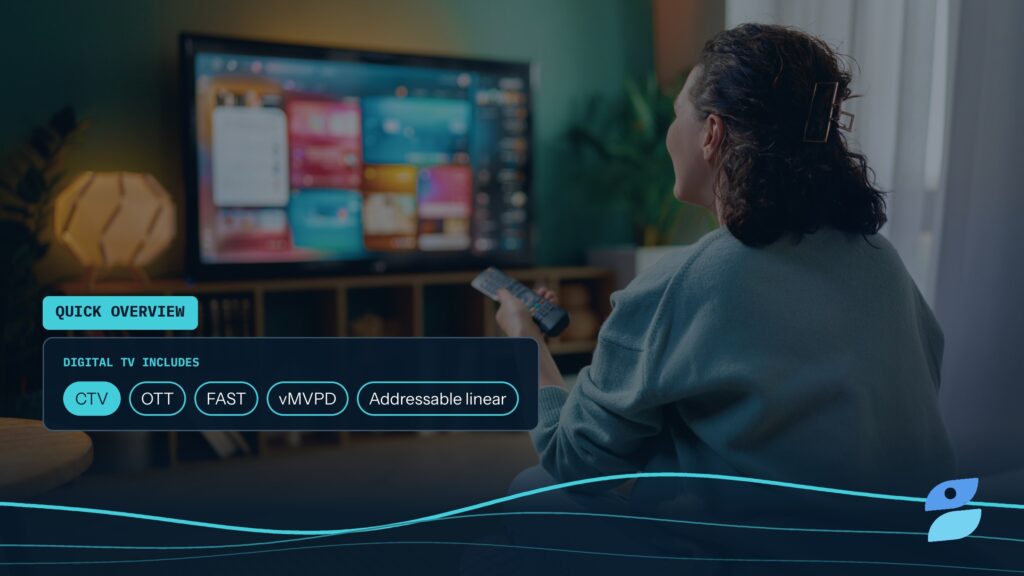
Digital TV advertising is any TV ad that’s served, targeted, and measured with data instead of a fixed broadcast schedule.
Key Highlights
- Digital TV advertising is an umbrella term covering CTV, OTT, FAST channels, vMVPDs, and addressable linear
- It combines television’s reach with digital-style targeting, buying, and measurement
- Most digital TV inventory is bought programmatically through DSPs and SSPs
- Supply path quality determines how well targeting and measurement actually work
- Curated deals make digital TV easier to plan alongside linear TV
Here’s what falls under the term and how it fits into a media plan.
What Is Digital TV Advertising?
Digital TV advertising refers to television ads delivered and decided through digital technology.
Traditional linear TV airs one ad to everyone watching a channel at the same moment. Digital TV can serve different ads to different households watching the same content.
The term gets used loosely. Some vendors treat it as a synonym for streaming TV advertising, but it’s broader than that. Our guide to what CTV is covers the largest piece.
The Main Types of Digital TV Advertising
Digital TV spans several formats that buyers often lump together.
The core types:
- Connected TV (CTV): ads in streaming apps viewed on smart TVs, streaming devices, and consoles
- Over-the-top (OTT): streaming content delivered over the internet to any screen
- Free ad-supported streaming TV (FAST): linear-style channels streamed for free
- Virtual multichannel video programming distributors (vMVPDs): live TV bundles streamed over the internet
- Addressable linear: cable and satellite ads swapped by household through set-top boxes
For the finer distinctions, see OTT vs. CTV and our breakdown of AVOD, SVOD, TVOD, and FAST.
Digital TV vs. Linear TV Advertising
The difference comes down to how the audience is bought.
Linear TV advertising buys an estimated audience based on programs and dayparts. Digital TV buys impressions one at a time, through real-time auctions or private deals.
What changes for buyers:
- Targeting: household-level data instead of broad demographics
- Buying: programmatic, with budgets that can shift mid-flight
- Measurement: impression-level reporting and outcome tracking
Linear still delivers large simultaneous reach, especially for live events. That’s why most plans use both, as our guide on how to buy television advertising explains.
How Digital TV Advertising Is Bought
Most digital TV inventory moves through programmatic pipes.
Advertisers and agencies bid through a demand-side platform (DSP). Publishers make inventory available through a supply-side platform (SSP), and the two connect through auctions built on the IAB Tech Lab OpenRTB standard.
Deals come in a few forms: open exchange, private marketplace (PMP), and programmatic guaranteed. Premium CTV inventory mostly trades through PMPs. Learn more in our guide to programmatic TV buying.
Where Digital TV Advertising Gets Complicated
The flexibility of digital TV also creates more room for waste.
Impressions can pass through several resellers before reaching your DSP. Each hop adds fees and can strip the data that makes targeting work, which is why supply path optimization matters.
Fragmentation is the other challenge, with audiences spread across many apps and devices. Meanwhile, expectations keep rising, and even local advertisers now want digital-level accountability from TV, as eMarketer’s look at local CTV targeting shows.
How Digital TV Fits Into a Media Plan
Treat digital TV as part of your TV plan, not a line item under digital.
Use linear for broad simultaneous reach and live moments. Use digital TV for targeted reach, incremental households, and measurable outcomes.
Our Ichiro curation platform helps here. We curate CTV supply across SSPs, enrich bid requests, and package it into PMP deals, including live sports, that traders activate in their existing DSP. For the full picture, read our connected TV advertising guide.
The Bottom Line
Digital TV advertising combines TV’s reach with digital’s precision across CTV, OTT, FAST, vMVPDs, and addressable linear.
Buy it programmatically, watch your supply path, and plan it alongside linear.
If you want a cleaner way into premium digital TV inventory, book a meeting with our team.
Frequently Asked Questions
Is digital TV advertising the same as CTV advertising?
Not exactly. CTV advertising is one part of digital TV advertising, covering ads in streaming apps on television screens. Digital TV is broader and also includes OTT on other devices, FAST channels, vMVPD live TV bundles, and addressable linear TV delivered through set-top boxes. In practice, though, CTV makes up much of what buyers mean by digital TV.
How is digital TV advertising measured?
Digital TV is measured at the impression level rather than through panel-based ratings alone. Buyers track impressions, completion rates, reach, and frequency, then tie exposure to outcomes like site visits or sales through household matching. Measurement quality depends on clean impression data, so supply paths with fewer resellers usually produce more reliable reports.
Is digital TV advertising more expensive than linear TV?
CPMs (cost per thousand impressions) on premium digital TV inventory are often higher than broad linear buys. However, digital TV wastes fewer impressions on households outside your target. So the effective cost to reach your actual audience can be lower. Compare cost per targeted household or cost per outcome, not raw CPM, when weighing the two.

Jake Gardner
The founder and CEO of Splash Bay Media, Jake has over 15 years of experience in digital marketing and ad tech. He’s built, scaled, and exited high-performance teams, products, and data-driven solutions that help advertisers and media partners succeed in an increasingly complex digital landscape. At Splash Bay, he leads the company’s strategic vision and growth, focusing on innovative traffic-shaping solutions, advanced analytics, and transparent supply-path optimization to drive efficiency, performance, and scale. He works closely across marketing, sales, client services, product, and finance to ensure we deliver measurable results and long-term value for our clients.