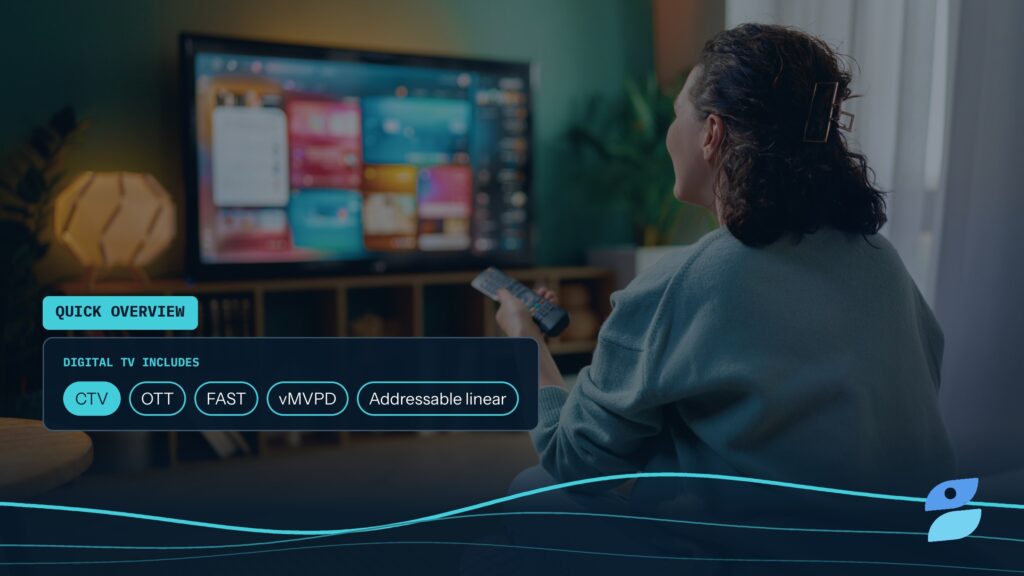
Programmatic TV buying is the automated purchase of TV ad inventory through software, replacing manual insertion orders and phone negotiations with data-driven, real-time transactions.
Key Highlights
- Programmatic TV buying uses automated platforms to transact TV ad inventory across CTV, streaming, and even linear broadcast
- Audience data replaces show ratings as the targeting foundation, so buyers reach households, not programs
- The three core deal types are open auction, private marketplace (PMP), and programmatic guaranteed
- Most performance problems in programmatic TV trace back to the supply path, not the creative or the DSP
- Curated inventory closes the gap between what buyers think they’re bidding on and what they actually get
Here’s how programmatic TV buying works, where it runs, and what separates campaigns that perform from campaigns that leak budget.
What Is Programmatic TV Buying?
Programmatic TV buying means transacting television ad inventory through automated systems instead of direct human negotiation.
In traditional TV media buying, an advertiser’s agency called a network’s sales team, negotiated rates against Nielsen ratings, and locked spots weeks in advance. Programmatic TV advertising replaces that process with software: demand-side platforms (DSPs) on the buy side, supply-side platforms (SSPs) on the sell side, and real-time decisioning in between.
The more important shift is what gets bought. Traditional buying purchases programs and dayparts. Programmatic buying purchases audiences. Instead of paying a premium because a show rates well, buyers bid on impressions where the household matches their target, whatever content that household happens to be watching.
For a deeper look at how this plays out specifically in streaming environments, see our guide to programmatic CTV advertising.
Programmatic TV vs. Traditional TV Buying
The difference comes down to speed, precision, and accountability.
Traditional TV buying: fixed upfront commitments, demo-based targeting (age and gender), delayed measurement through panel ratings, and high minimum spends that lock out smaller advertisers.
Programmatic TV buying: real-time or automated transactions, household-level audience targeting, impression-based measurement, and entry points at nearly any budget.
Neither model is going away entirely. Upfronts still dominate premium linear sports and tentpole events. But the center of gravity has moved, and it has moved fast: eMarketer projects 88% of US CTV ad spend will transact programmatically this year, and linear inventory is increasingly available through the same pipes.
Where Programmatic TV Buying Runs
Programmatic TV buying spans three environments, and the mechanics differ in each.
Connected TV (CTV): streaming content delivered through smart TVs, streaming sticks, and gaming consoles. This is where programmatic TV is most mature. Every impression is addressable, meaning buyers can target and measure at the household level.
Programmatic linear TV: automated buying of traditional broadcast and cable spots. Targeting is coarser than CTV, but automation still cuts the manual workflow and opens linear inventory to buyers who could never access it through upfronts.
Addressable TV advertising: household-level ad delivery within linear programming, typically through set-top box data. Two neighbors watching the same broadcast can see different ads.
In practice, sophisticated buyers plan across all three from a single DSP seat, with shared audience definitions and unified frequency management.
The Three Deal Types That Matter
How you access inventory shapes everything about how your campaign performs.
Open auction: inventory is available to any bidder in real time. Maximum reach and flexibility, minimum transparency. In CTV specifically, open exchange buying carries elevated fraud and reseller risk.
Private marketplace (PMP): an invitation-only auction where a curator or publisher packages specific inventory behind a deal ID. Buyers know what they’re bidding on, and sellers control who bids. This is where most serious CTV spend has migrated, and it’s the model our Ichiro platform is built around.
Programmatic guaranteed: a fixed-price, reserved commitment executed programmatically. Closest to a traditional buy, with the automation and data layered on top.
The pattern across the industry is clear: as budgets grow, buyers move from open auction toward curated deals, because knowing exactly what supply you’re buying is worth more than marginal reach.
Where Programmatic TV Budgets Leak
Automation solved the workflow problem, but it created a transparency problem.
Between a DSP bid and a delivered impression sits a chain of intermediaries: exchanges, resellers, and sometimes resellers of resellers. Each hop takes a fee. Worse, each hop degrades signal, so the impression a buyer thinks is premium, on-screen CTV inventory may be something else entirely by the time it renders.
The common leak points include:
- Duplicate supply paths: the same impression offered through multiple resellers at different prices
- Misrepresented inventory: mobile or desktop video packaged and sold as CTV
- Bloated hidden fees: intermediary take rates that never appear on an invoice
- Made-for-advertising content: low-quality FAST channels engineered to farm ad calls
This is why supply path optimization has become a core discipline for agency traders, and why IAB Tech Lab’s CTV programmatic standards put so much emphasis on transparent inventory description. The fix isn’t buying less programmatically. It’s buying through fewer, cleaner, verified paths.
How Curation Makes Programmatic TV Buying Perform
Curation is the supply-side answer to the transparency problem.
Instead of leaving buyers to filter the open exchange themselves, a curation layer sits between SSPs and DSPs, packaging verified inventory, enriched bidstream data, and audience signals into deal IDs that activate in any DSP. Our approach with Ichiro is SSP-agnostic: we curate across supply sources rather than locking buyers into a single exchange’s inventory, then enrich each bid request with data the DSP wouldn’t otherwise see.
For a trader, the practical difference looks like this:
- One deal ID instead of dozens of supply paths to test and police
- Verified CTV inventory with app-level transparency, not bundle-level guesses
- Bid enrichment that improves targeting precision without third-party cookies
- Direct-path economics with fewer intermediary fees between bid and impression
We break down our thinking on transparency in more detail on our Why No B.S. page, because that’s genuinely the philosophy behind how we package supply.
The Bottom Line
Programmatic TV buying is the automated, data-driven purchase of TV ad inventory across CTV, linear, and addressable environments, and it has become the default way television is transacted. The automation is table stakes. What actually determines performance is the supply path: what inventory you access, how many hands touch it, and how much signal survives the journey.
Buyers who treat programmatic TV as “set the DSP and forget it” inherit the open exchange’s problems. Buyers who work through curated, verified supply get the efficiency of automation and the confidence of a direct buy. If you want to see what curated programmatic TV supply looks like in practice, book a meeting with our team.
Frequently Asked Questions
What is the difference between programmatic TV and CTV?
Programmatic TV describes how inventory is bought: through automated, data-driven platforms. CTV describes where the ad runs: streaming content on internet-connected televisions. CTV is the largest and most mature environment for programmatic TV buying, but programmatic transactions also extend to linear broadcast and addressable inventory. In short, CTV is a channel, and programmatic is a buying method.
Is programmatic TV buying only for large advertisers?
No, and that’s one of its biggest advantages over traditional TV. Upfront linear commitments historically required six- or seven-figure minimums, which priced out most advertisers. Programmatic TV buying lets advertisers enter at nearly any budget, target specific households instead of broad demos, and scale spend based on measured performance rather than upfront guesses.
How do PMP deals work in programmatic TV?
A private marketplace (PMP) deal is an invitation-only auction identified by a deal ID. A curator or publisher packages specific inventory, often with audience data attached, and makes it available to selected buyers. The trader activates the deal ID inside their existing DSP seat, so there’s no platform switch. PMPs trade some open-market reach for transparency, verified quality, and cleaner supply paths.

Jake Gardner
The founder and CEO of Splash Bay Media, Jake has over 15 years of experience in digital marketing and ad tech. He’s built, scaled, and exited high-performance teams, products, and data-driven solutions that help advertisers and media partners succeed in an increasingly complex digital landscape. At Splash Bay, he leads the company’s strategic vision and growth, focusing on innovative traffic-shaping solutions, advanced analytics, and transparent supply-path optimization to drive efficiency, performance, and scale. He works closely across marketing, sales, client services, product, and finance to ensure we deliver measurable results and long-term value for our clients.