Television Advertising in 2026: Still Worth It?
Television advertising is still worth it in 2026, but the TV you’re buying looks nothing like it did five years ago.
Key Highlights
- Streaming now accounts for nearly half of all US TV viewing, while broadcast and cable together hold roughly 36%.
- Most TV time is still ad-supported, so the audience is there; what has changed is where it watches.
- Linear TV advertising still wins for live sports, tentpole events and fast mass reach.
- Streaming TV advertising adds household targeting, digital-style measurement and lower entry costs.
- The best 2026 plans treat linear and streaming as one TV budget, with supply quality deciding where streaming dollars perform.
So the real question isn’t whether to buy TV. It’s which TV to buy, and how.
Where TV Viewing Actually Stands in 2026
The audience never left television. It moved to different screens and apps.
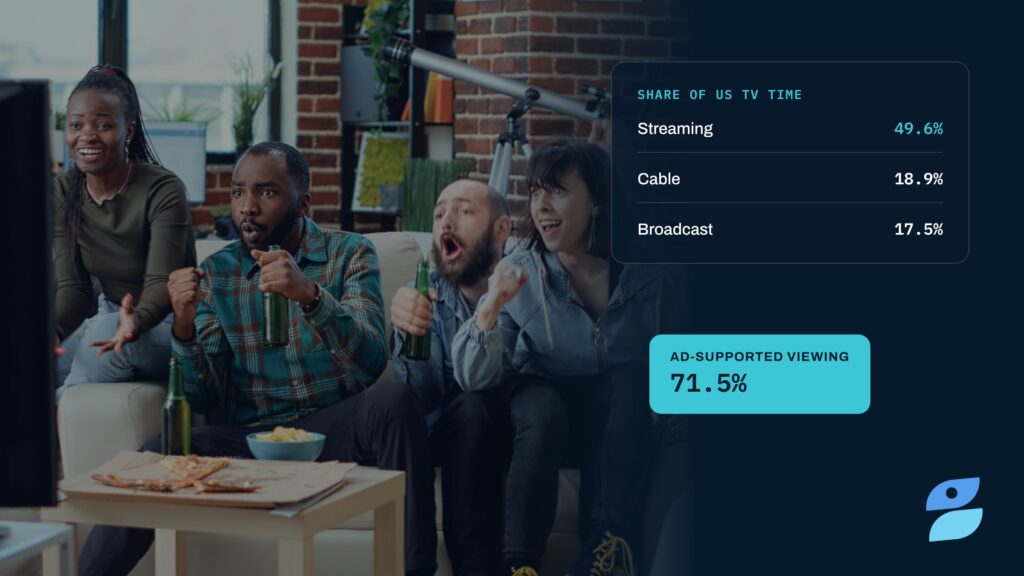
According to Nielsen’s August 2026 Gauge, streaming took 49.6% of total US TV time. Cable held 18.9% and broadcast 17.5%, while YouTube alone reached a record 15.8%.
That shift matters for advertisers, but it doesn’t mean TV ads are dying. In Nielsen’s Q2 2026 Ad Supported Gauge, 71.5% of all TV viewing happened in ad-supported environments. Streaming made up 48.2% of that ad-supported time.
The takeaway: most TV viewers still watch ads. They just watch more of them through streaming apps than through a cable box.
Is Television Advertising Still Worth It?
For most brands with a reach or awareness goal, yes. TV still delivers something few other channels can: full-screen, sound-on video in the living room, often watched by more than one person.
The budget data backs this up. IAB’s 2026 outlook projects CTV ad spend growing 13.8% this year, while linear TV declines just 1.7%. That’s a far softer drop than linear’s 14.4% contraction in 2025.
Buyers aren’t abandoning TV. They’re rebalancing it.
TV is less likely to be worth it when:
- Your budget can’t support enough frequency. A handful of spots spread thin rarely moves results.
- Your goal is pure last-click conversion. Search and social still close the loop faster.
- You buy streaming blind. Open-exchange CTV without supply controls can waste a meaningful share of spend.
Advantages of Television Advertising Today
The advantages of television advertising have grown, not shrunk, now that streaming is part of the mix.
- Attention: TV ads play full screen with sound on, and CTV ads are usually non-skippable
- Reach: broadcast and live sports still assemble huge audiences in a single moment
- Trust: premium TV content gives brands a credible, brand-safe environment
- Co-viewing: one impression often reaches a whole household
- Halo effect: TV exposure lifts search, site traffic and social engagement on other channels
Streaming adds what linear never had: targeting by household, measurement tied to outcomes, and the ability to start with a smaller budget.
Linear TV Advertising vs. Streaming TV Advertising
Linear and streaming each do a different job. Knowing which job you need decides the split.
Linear TV advertising works best for:
- Live sports, news and tentpole events
- Fast national or local reach at scale
- Audiences that still watch through cable or antenna, which skew older
Streaming TV advertising works best for:
- Reaching cord-cutters and younger households
- Targeting specific audiences, geographies or interests
- Measuring site visits, conversions and incremental reach
- Flexible budgets, with no upfront commitment required
For a deeper look at the formats behind each, our guide to connected TV advertising breaks down how streaming inventory is bought and sold.
How Much Does TV Advertising Cost?
TV advertising cost depends on the channel, the market and when your spot airs.
Linear TV: pricing is set per spot. A 30-second local ad in a smaller market costs a small fraction of a national prime-time spot, and major live sports sit at the top of the range.
Streaming TV: priced on a CPM (cost per thousand impressions) basis. Rates vary with targeting, publisher and deal type, and campaigns can start at much smaller budgets than a national linear buy.
Production adds to either. The good news is that one well-made spot can run across both linear and streaming.
Measuring TV Advertising Effectiveness
TV advertising effectiveness used to rest on ratings and estimates. Now buyers can measure much more.
Upper funnel: reach, frequency, completion rate and brand lift studies
Mid funnel: site visits, search lift and app opens tied to exposed households
Lower funnel: conversions and incrementality, measured with holdout tests
Pick one primary KPI before launch and build measurement around it. Our post on setting goals in CTV advertising walks through how to match KPIs to objectives.
Once results come in, Hillstone, our CTV campaign optimization service, uses that performance data to shift spend toward the supply paths that hit your KPI.
How to Decide Your TV Mix in 2026
Start with your objective, then let it shape the split.
- Building awareness fast? Lead with linear and live sports, then extend reach with streaming.
- Reaching a defined audience? Lead with streaming, using household targeting and frequency caps.
- Launching locally? Combine local broadcast with geotargeted streaming in the same markets.
- Testing TV for the first time? Start with streaming to learn at a lower cost, then scale what works.
When you’re ready to plan the streaming side, PubHub, our CTV planning platform, lets you build packages by audience, show or live sports event and estimate reach before you commit.
Whatever the split, plan TV as one budget. Separate linear and streaming plans tend to duplicate reach and overspend on frequency.
Where Streaming Budgets Go Wrong
Moving budget to streaming only pays off if the inventory is real, premium and worth the price.
Much CTV supply passes through several resellers before it reaches your DSP. Each hop adds fees and fraud risk, and some impressions sold as CTV never run on a TV at all. Our trader’s guide to supply path optimization explains how to cut those wasteful paths.
That’s where we focus. Ichiro, our CTV curation platform, packages premium streaming inventory across multiple SSPs into deals you activate in the DSP you already use. We add show-level and live sports signals so your streaming dollars land where the audience actually watches.
The Bottom Line
Television advertising is still worth it in 2026, but only if you buy TV the way people watch it now.
Linear still owns live events and fast mass reach. Streaming brings the audience growth, targeting and measurement. The brands getting the most from TV plan both together and hold their streaming supply to a high standard.
Want to see what curated streaming inventory could add to your TV plan? Talk to our team about your next campaign.
Frequently Asked Questions
Is TV advertising still effective in 2026?
Yes. Nielsen reports that 71.5% of US TV viewing in Q2 2026 happened in ad-supported environments, so most viewers still see TV ads. What has changed is where they watch. Streaming now holds nearly half of total TV time, so effective plans pair linear TV for live events and broad reach with streaming for targeting and measurement.
What is the difference between linear and streaming TV advertising?
Linear TV advertising runs on scheduled broadcast and cable programming and is usually bought by the spot. Streaming TV advertising runs inside apps and services delivered over the internet, usually bought by CPM. Streaming allows household-level targeting and outcome measurement, while linear still delivers the biggest live audiences, especially for sports and news.
How much should I budget for TV advertising?
It depends on your goal, market and channel mix. Local linear spots and streaming campaigns can start at modest budgets, while national prime-time and live sports require much more. Budget enough to reach meaningful frequency in your target audience, because thin campaigns rarely move results, and leave room for production.
Should small businesses advertise on TV?
Often, yes, especially through streaming. Streaming TV advertising lets small businesses target specific zip codes, audiences and interests with smaller budgets and no long-term commitment. Local broadcast can also work well in smaller markets. Start with a focused test, measure site visits or leads, then scale what performs.

Jake Gardner
The founder and CEO of Splash Bay Media, Jake has over 15 years of experience in digital marketing and ad tech. He’s built, scaled, and exited high-performance teams, products, and data-driven solutions that help advertisers and media partners succeed in an increasingly complex digital landscape. At Splash Bay, he leads the company’s strategic vision and growth, focusing on innovative traffic-shaping solutions, advanced analytics, and transparent supply-path optimization to drive efficiency, performance, and scale. He works closely across marketing, sales, client services, product, and finance to ensure we deliver measurable results and long-term value for our clients.