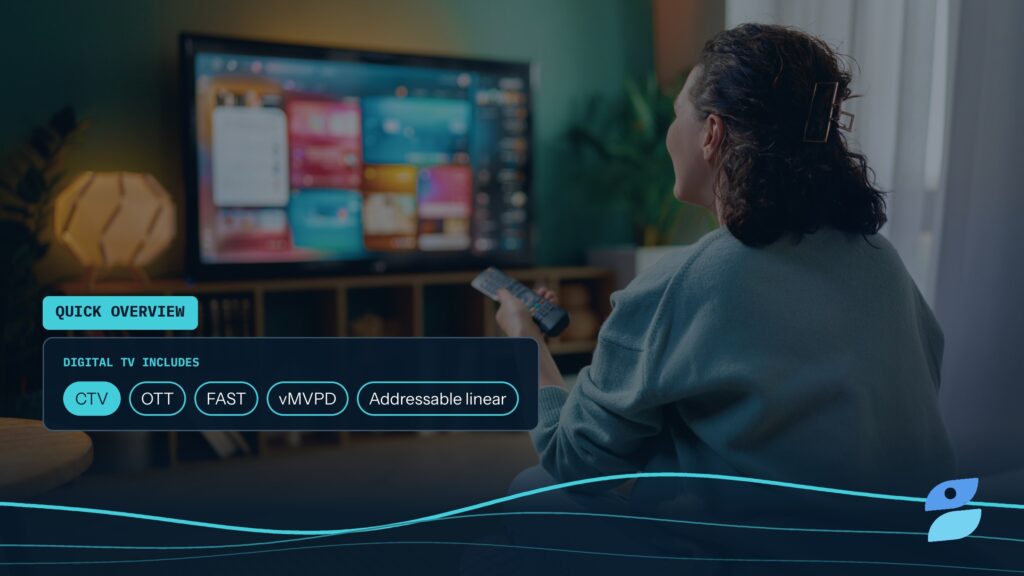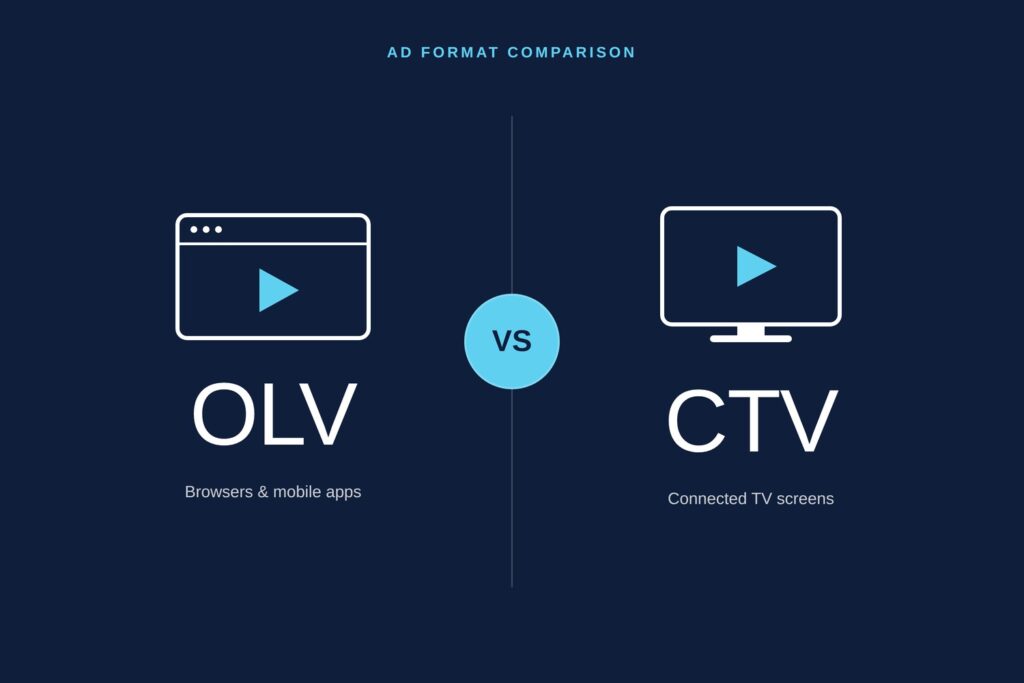
OLV advertising and connected TV (CTV) both buy video impressions, but they behave like two different channels the moment a campaign goes live.
Key Highlights
- OLV advertising describes video ads served in browsers and mobile apps, while CTV describes video ads served on internet-connected television devices.
- Format rules diverge sharply, because OLV inventory splits across in-stream, accompanying content, interstitial, and standalone placements, while CTV is almost entirely full-screen and non-skippable.
- CTV carries higher CPMs (cost per thousand impressions) and stronger completion rates, while OLV delivers cheaper reach and more granular targeting signals.
- Measurement differs at the root, because OLV supports clicks and pixel-based attribution and CTV does not.
- Most video plans need both, with CTV anchoring reach and quality and OLV extending frequency at a lower cost.
Here is how the two compare across the dimensions that actually change how you buy.
What OLV Advertising Means
OLV stands for online video, and it covers video ads that run in a browser or a mobile app rather than on a television screen.
The OLV marketing term includes pre-roll on a publisher’s video player, video units placed inside an article, and video in a content feed. The IAB digital video in-stream ad format guidelines separate these placements based on whether the ad monetizes video content the user actively requested.
CTV sits outside that definition. A CTV impression is served to a smart TV, streaming stick, game console, or set-top box inside an ad-supported streaming app, and it never renders in a scrolling page.
Devices and Viewing Environments
Device context is the root cause of nearly every other difference on this list.
OLV runs on desktops, laptops, phones, and tablets. These are personal screens, frequently muted by default, and consumed in short sessions between other tasks.
CTV runs on the living room screen with sound on and the full screen occupied. More than one person is often watching, so co-viewing changes both your reach math and your creative approach. If the delivery mechanism matters to your buy, the OTT and CTV distinction is worth separating out as well.
Ad Formats and Creative Requirements
Format is where the two channels stop being interchangeable.
OLV formats:
- in-stream pre-roll, mid-roll, and post-roll inside a publisher’s video player
- accompanying content and interstitial placements that sit beside or between editorial
- standalone units in feeds and articles, usually muted at start and often skippable
- common lengths of 6, 15, and 30 seconds, with clickable creative
CTV formats:
- full-screen, non-skippable spots at 15 and 30 seconds
- sound on by default, with no clickthrough available in the moment
- QR codes, home screen units, and interactive overlays as the workaround for direct response
- broadcast-quality file specs, which means OLV creative rarely ports over unchanged
Plan creative for both from the start, because reformatting a social cutdown for the living room screen is the most common late-stage delay we see.
Inventory and Supply Paths
Supply is the messiest part of OLV advertising, and the strongest argument for curation.
When the video ad format guidelines were amended, the in-stream definition tightened considerably. AdExchanger reported that roughly 90% of what previously counted as in-stream video inventory was reclassified as out-stream under the updated video guidelines. Buyers who assume they are purchasing true in-stream often are not.
CTV supply is consolidated at the publisher level but badly fragmented at the SSP (supply-side platform) level. The same streaming app can be reachable through five different paths at five different prices, which is why supply path optimization for CTV is now table stakes rather than an advanced tactic.
That is the problem our Ichiro curation platform was built to solve. Because we stay SSP agnostic, we package inventory across supply paths instead of defending one, which keeps deal quality ahead of deal convenience.
Targeting Differences
Both channels target well, but they resolve identity in completely different ways.
OLV leans on browser and device-level signals: contextual placement, publisher first-party segments, and retargeting pools built from site pixels. Granularity is high, though signal loss keeps eroding the durability of those audiences.
CTV resolves at the household level through IP address, device graphs, and automatic content recognition. You give up user-level precision and gain a clean, deterministic household match that works well for programmatic CTV campaigns built on offline or CRM data.
For political and healthcare buyers, that household-level model is usually the advantage rather than the compromise, since geographic and district-level precision matters more than individual identity.
Viewability and Completion
Viewability means something different on a scrolling page than it does on a television screen.
The Media Rating Council (MRC) standard counts a video impression as viewable when at least 50 percent of pixels are in view for a minimum of two continuous seconds, per the MRC viewable impression guidelines. OLV has to fight for that threshold, because units can autoplay below the fold or scroll out of view mid-play.
CTV clears it structurally. There is no viewport to scroll, the ad occupies the full screen, and the spot cannot be skipped, so completion rates sit far above what OLV inventory typically returns.
Pricing and CPM Expectations
Expect to pay a premium for the living room screen.
CTV CPMs run substantially higher than OLV CPMs because supply is finite, content is premium, and inventory increasingly clears through upfront commitments. eMarketer projects that CTV will surpass primetime linear TV in US upfront ad spending in 2026, which tells you where the pricing pressure is heading.
OLV buys cheap reach, but the gap narrows once you evaluate on cost per completed view rather than raw CPM. Skipped and non-viewable impressions are still billed, so a low CPM can produce an unimpressive effective cost. Where you buy matters as much as what you pay, and not every platform marketed as CTV is built for it.
Measurement and Attribution
The measurement gap is the hardest part of this comparison to plan around.
OLV supports clicks, pixels, view-through windows, and cost per completed view. Attribution is imperfect but familiar, and most performance teams already have the reporting built.
CTV has no click. Proving impact means incrementality testing, household-level conversion lift, media mix modeling, and log-level delivery data rather than a last-touch report.
Do not force a single attribution model across both channels, because the false comparison usually ends with CTV budget getting cut for the wrong reason.
When to Use OLV Advertising and When to Use CTV
Neither channel wins outright, so the split should follow the objective.
Lead with CTV when:
- brand impact, premium adjacency, or full-screen attention drives the goal
- live sports or event packaging is part of the buy
- household-level targeting is sufficient and offline data is the strongest signal
- the campaign is political or regulated and geographic precision matters most
Lead with OLV when:
- budget is tight and incremental reach matters more than production quality
- you need retargeting, sequential messaging, or a clickable path to conversion
- audience granularity beyond the household is required
- you are extending frequency against an audience CTV already reached
Run both when you want the living room screen to carry the message and cheaper online video to carry the frequency, which describes most upper-funnel plans with a performance requirement attached.
The Bottom Line
OLV advertising and CTV are not competing line items, they are complementary layers with different economics, formats, and proof standards.
Treat them separately in planning: different creative specs, different targeting logic, different measurement frameworks. Treat them together in budgeting, because the reach and frequency math only works when both are on the plan.
The part worth getting right is supply. Fragmented paths, misclassified in-stream inventory, and duplicated CTV routes quietly inflate cost in both channels, which is exactly what curation is supposed to fix. Start with our complete guide to connected TV advertising for the wider channel picture, see how we approach curation without the B.S., or book a meeting with our team to talk through your video split.
Frequently Asked Questions
What is OLV in advertising?
OLV means online video, and it refers to video ads delivered in a web browser or mobile app rather than on a television screen. It includes pre-roll on publisher video players, in-article video, and video units in content feeds. OLV is bought programmatically through a DSP, and it is measured with clicks, viewability, and completion rate.
Is CTV a type of OLV advertising?
No. CTV is a separate channel, even though both deliver digital video. OLV ads serve to browsers and mobile apps on personal screens, while CTV ads serve to internet-connected televisions inside streaming apps. The distinction matters because format specs, targeting methods, pricing, and attribution models all differ between the two.
Do OLV ads or CTV ads perform better?
It depends on the objective. CTV delivers stronger completion rates, full-screen attention, and premium content adjacency, which suits brand and reach goals. OLV delivers cheaper impressions, clickable creative, and finer audience granularity, which suits retargeting and frequency extension. Most effective video plans run both and measure each against its own benchmark.

Jake Gardner
The founder and CEO of Splash Bay Media, Jake has over 15 years of experience in digital marketing and ad tech. He’s built, scaled, and exited high-performance teams, products, and data-driven solutions that help advertisers and media partners succeed in an increasingly complex digital landscape. At Splash Bay, he leads the company’s strategic vision and growth, focusing on innovative traffic-shaping solutions, advanced analytics, and transparent supply-path optimization to drive efficiency, performance, and scale. He works closely across marketing, sales, client services, product, and finance to ensure we deliver measurable results and long-term value for our clients.