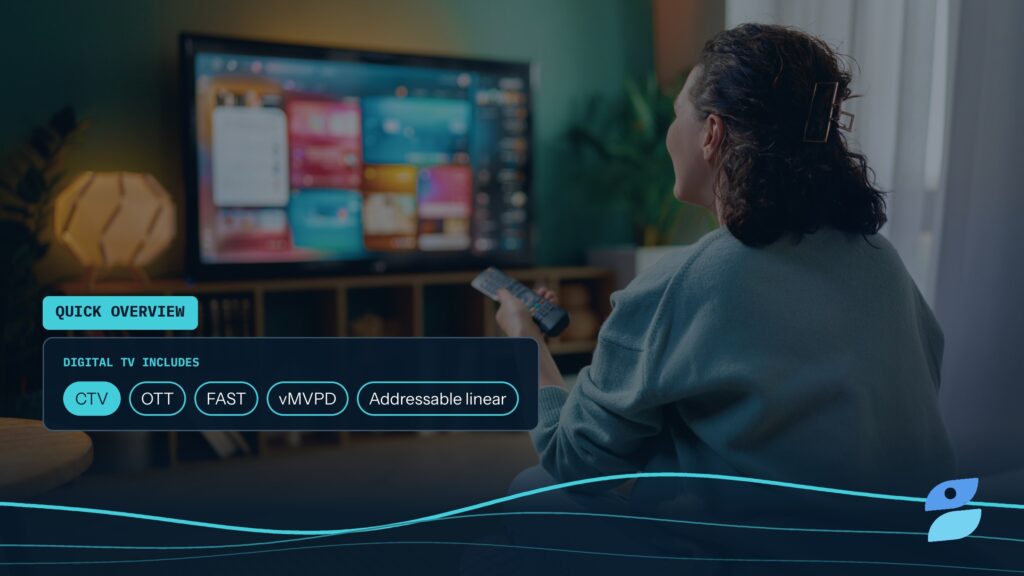
Connected TV advertising has crossed from emerging channel to must-buy: it’s where your audience already is, and it’s where programmatic precision finally meets the biggest screen in the house.
Key Highlights
- Connected TV (CTV) delivers video ads to viewers on internet-connected televisions through streaming apps, with no cable bundle required.
- CTV inventory is bought programmatically through DSPs, using real-time bidding, private marketplace deals, or programmatic guaranteed arrangements.
- CTV audience targeting goes well beyond demographics, supporting first-party data, behavioral signals, and household-level precision.
- CTV vs. linear TV comes down to one thing: control. CTV lets you buy audiences, not just time slots.
- Inventory quality and supply path matter. Not all CTV impressions are equal, and curation is the difference between efficient reach and wasted spend.
The bottom line: if you’re still treating CTV as a test-and-learn budget line, you’re already behind.
What Connected TV Advertising Actually Is
Connected TV advertising is video advertising delivered inside streaming content on internet-connected televisions.
The device could be a smart TV, a Roku, an Apple TV, an Amazon Fire Stick, or a gaming console. What they share: internet connectivity, streaming apps, and ad-supported inventory that a programmatic buyer can access through a DSP.
This is distinct from OTT (over-the-top), which refers to the delivery method across any internet-connected device, including phones and tablets. CTV is specifically the big-screen environment. When traders and DSP managers talk about connected TV advertising, they mean premium, full-screen, non-skippable video in a lean-back viewing context.
The ad itself is served through dynamic ad insertion (DAI): the streaming platform identifies an available impression, sends a bid request, and the winning creative is dropped into the content stream in real time. Video completion rates on CTV consistently run 92–97%, because most streaming environments don’t allow the viewer to skip.
How CTV Programmatic Buying Works
The mechanics follow the same DSP-SSP architecture you already work in, with a few CTV-specific considerations. The IAB Tech Lab’s CTV Programmatic Guide outlines the full technical spec, but here’s the practical version.
When a viewer launches a streaming app, the platform generates an ad opportunity and passes a bid request through its SSP. The bid request includes device type, content genre, audience data, and deal parameters. Your DSP evaluates the request against your targeting criteria and bids accordingly. The whole process happens in under 100 milliseconds.
The deal type you use determines how much control and inventory access you get:
- Programmatic Guaranteed (PG): Fixed CPM, reserved impressions, automated execution. The closest programmatic equivalent to a direct buy.
- Private Marketplace (PMP): Curated inventory packages with preferred pricing. Better signal quality and supply transparency than open auction.
- Open Auction (RTB): Broadest scale, least control. Quality variance is significant, and supply path complexity is a real issue at scale.
The market has already voted. According to Pixalate’s 2026 CTV market analysis, PMPs account for 32% of programmatic CTV spend and PG deals another 32%, meaning nearly two-thirds of CTV transacts through controlled, curated deal structures. Sophisticated buyers are leaning on curated supply for a reason: it’s where inventory quality, measurement fidelity, and CPM efficiency actually align.
This is where our Ichiro platform is built to operate. Rather than sending your DSP into a sprawling open auction, Ichiro curates CTV inventory across SSPs, applying bid enrichment and supply-path optimization so every impression you buy is working harder before the bid is even placed.
CTV Audience Targeting: What’s Actually Possible
CTV audience targeting is the capability that finally makes television a precision channel.
Linear TV targeting was demographic at best: adults 25–54, households with income above a threshold. Connected TV lets you layer in behavioral data, first-party segments, purchase intent signals, and geographic precision down to the ZIP code. A few practical targeting approaches:
- First-party data activation: Match your CRM or DMP audiences to CTV households for retargeting or lookalike expansion.
- Behavioral and interest segments: Reach viewers based on content consumption patterns, browsing behavior, or in-market signals from third-party data partners.
- Contextual targeting: Align creative to content genre, network, or daypart without relying on user-level identity.
- Geographic precision: Target by DMA, ZIP code, or custom radius. Useful for political, retail, and local-market campaigns.
One important nuance: CTV targeting operates at the household level, not the individual user level. One impression reaches the device, not a verified person. Frequency capping across households is critical, because overexposure on the big screen degrades performance faster than on mobile.
CTV vs. Linear TV: The Real Difference
The CTV vs. linear TV debate isn’t about which channel is better. It’s about what each one does.
Linear TV is a broadcast medium. You buy a time slot, your ad reaches everyone watching that network at that moment, and you measure success with estimated GRPs. Scale is real, but audience precision is limited and attribution is slow.
Connected TV advertising is an impression-level medium. You buy a specific household, in a specific content environment, at a specific moment, with a target audience signal attached. Attribution is direct: you can track site visits, app downloads, and downstream conversions tied to CTV exposure.
Modern media plans use both, and for good reason. Linear delivers synchronous reach at scale, particularly for live sports and cultural moments. CTV manages frequency, fills in incremental households that linear missed, and handles the performance accountability that brand teams increasingly need to justify TV spend.
Where CTV wins outright: measurement. GRPs tell you estimated reach. CTV programmatic tells you households reached, video completion rate, frequency by household, view-through conversions, and incremental lift. That level of reporting is why 54% of CTV buyers now define success by business outcomes — sales, site visits, leads — rather than reach metrics.
CTV Inventory Quality: Why Curation Matters
Not all connected TV advertising inventory is equal, and this is where agency traders and DSP managers need to pay close attention.
The open CTV market has real problems. App fraud, spoofed inventory, impressions served to inattentive screens, and supply paths with excessive intermediary fees all erode campaign performance. As eMarketer notes, most CTV inventory transacts through programmatic direct and private marketplace deals rather than open auctions — and for good reason. Premium publishers prioritize direct deals and curated PMPs for their best inventory. What reaches the open auction is often the remnant.
Curation is the answer. A curated CTV inventory approach means pre-vetting publishers, establishing direct supply relationships, and packaging inventory with enriched bidstream data so buyers know exactly what they’re getting before they bid.
Our Ichiro platform is SSP-agnostic by design, which means we access premium CTV supply across the ecosystem rather than being locked into one supply chain. We layer in bid enrichment signals so your DSP isn’t flying blind on inventory quality. For agencies running CTV at scale, that supply-path transparency is the difference between efficient spend and a Q4 post-mortem explaining why completion rates were below benchmark.
We also package live sports inventory and FAST channel supply, two of the fastest-growing CTV environments, into deal structures that give buyers premium inventory access without the complexity of negotiating each publisher relationship directly.
The Bottom Line
Connected TV advertising is no longer a channel to test. It’s where streaming audiences live, and programmatic infrastructure has matured to the point where CTV can be bought with the same precision and accountability as any digital channel.
The buyers winning in this environment are the ones who treat inventory quality and supply-path efficiency as seriously as audience targeting. Reach without curation is wasted spend. Curation without the right platform infrastructure is just overhead.
If you want to see how Ichiro’s curated CTV approach translates into cleaner supply and better bid efficiency for your campaigns, book a meeting with our team.
Frequently Asked Questions
What is connected TV advertising?
Connected TV (CTV) advertising delivers video ads to viewers watching streaming content on internet-connected televisions, including smart TVs, Roku devices, Apple TV, and gaming consoles. Ads are served programmatically through DSPs and SSPs using real-time bidding or private marketplace deals, giving buyers household-level targeting and performance measurement that linear TV cannot match.
How is CTV advertising different from OTT advertising?
OTT (over-the-top) refers to streaming content delivered over the internet across any device, including phones and tablets. CTV is a subset of OTT that refers specifically to the big-screen, television environment. When programmatic buyers reference CTV advertising, they mean full-screen video inventory on actual TV devices, which typically carries higher engagement and completion rates than mobile or desktop OTT placements.
What targeting options are available in connected TV advertising?
CTV audience targeting supports first-party data segments, behavioral and interest-based audiences, purchase intent signals, contextual targeting by content genre or network, and geographic precision down to the ZIP code. Targeting operates at the household level rather than the individual user level, which means frequency capping across households is essential for campaign efficiency.
Why does CTV inventory quality vary so much?
Premium publishers typically reserve their best CTV inventory for direct deals and curated private marketplaces. Open auction inventory often consists of remnant impressions that didn’t clear through preferred channels, and the open CTV market still carries risks including app fraud, spoofed inventory, and supply-path opacity. Buyers who work with curated inventory platforms get pre-vetted supply with enriched bidstream data, reducing waste and improving campaign performance.
What metrics should I track for connected TV advertising?
Core CTV metrics include video completion rate (VCR), household reach, frequency, and view-through conversions. As measurement infrastructure matures, leading buyers are also tracking incremental lift, brand search lift, and downstream business outcomes like site visits and purchases. GRPs and estimated reach are no longer sufficient benchmarks for programmatic CTV campaigns.

Jake Gardner
The founder and CEO of Splash Bay Media, Jake has over 15 years of experience in digital marketing and ad tech. He’s built, scaled, and exited high-performance teams, products, and data-driven solutions that help advertisers and media partners succeed in an increasingly complex digital landscape. At Splash Bay, he leads the company’s strategic vision and growth, focusing on innovative traffic-shaping solutions, advanced analytics, and transparent supply-path optimization to drive efficiency, performance, and scale. He works closely across marketing, sales, client services, product, and finance to ensure we deliver measurable results and long-term value for our clients.