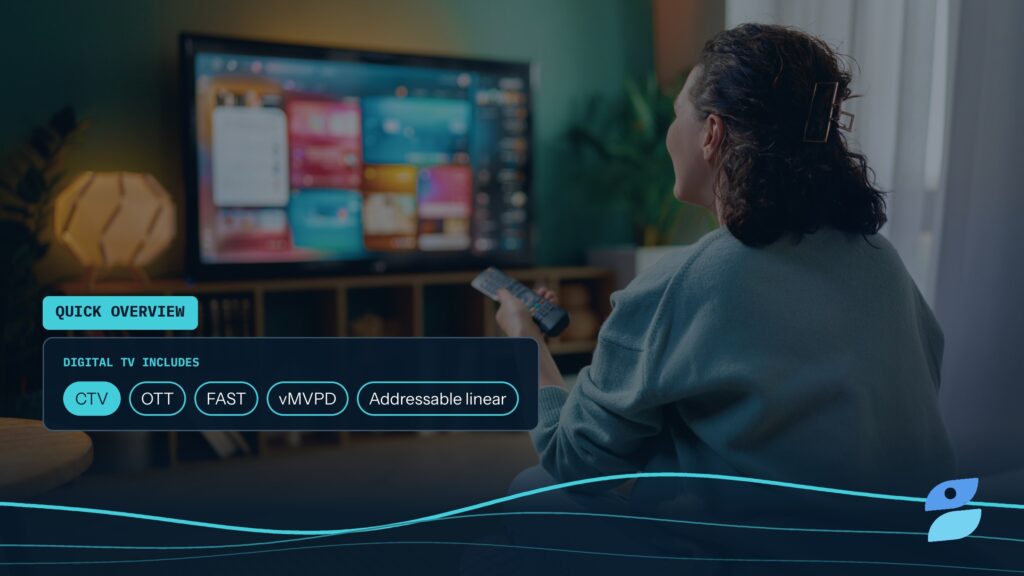
Television advertising has never been more accessible, or more complex.
Knowing how to buy television advertising today means navigating linear broadcast, cable, and programmatic CTV simultaneously, each with its own inventory structure, pricing logic, and measurement approach. This guide breaks down the full process so you can plan, buy, and measure a TV campaign with confidence.
Key Highlights
- TV advertising spans linear broadcast, cable, and connected TV (CTV), each with distinct buying mechanics and audience profiles.
- Effective media buying starts with clear objectives, a defined audience, and a budget aligned to your goals.
- Programmatic TV advertising automates inventory access and enables data-driven targeting at scale.
- Strong television commercial production is essential; even the best-placed ad fails without compelling creative.
- Measuring performance requires tracking the right KPIs, from reach and frequency to cost per completed view and conversion lift.
Introduction to TV Advertising
Television advertising remains one of the most powerful channels for building brand awareness and driving purchase intent.
That statement holds even as the medium has fractured.
Linear broadcast, cable, streaming, and connected TV (CTV) now coexist in the same media plan, and each comes with its own buying process, pricing structure, and audience dynamic. For buyers new to the channel, that complexity is exactly where deals get mispriced and campaigns underperform.
This guide covers how to buy television advertising from the ground up. Whether you are planning your first TV campaign or trying to understand how programmatic fits into your existing media strategy, you will leave with a clear framework for buying smarter.
What Is Media Buying?
Media buying is the process of purchasing advertising placements across channels, negotiating rates, managing inventory, and optimizing spend toward campaign goals.
In the television context, media buying means securing airtime on broadcast networks, cable channels, or streaming platforms so your ad reaches the right viewers at the right moment.
It is both a negotiation function and a strategic one. Bad media buying wastes budget on the wrong audiences. Good media buying compounds results across every dollar spent.
The Role of Media Buyers
Media buyers are responsible for translating a media plan into live, running placements.
Their job covers a wide surface: they research inventory options, negotiate rates with networks or exchanges, execute buys through direct deals or programmatic platforms, and monitor delivery throughout a campaign flight. In larger organizations, media buyers work alongside media planners who set strategy. In smaller teams or agencies, one person often covers both functions.
Key Terms to Know
Before buying television advertising, get familiar with this vocabulary. Nielsen’s TV measurement glossary is a useful reference for understanding how audience metrics are defined and tracked across the industry.
- Gross Rating Point (GRP): a unit of measurement equal to 1% of the target audience exposed to an ad.
- Cost Per Thousand (CPM): the cost to reach 1,000 viewers with a single impression.
- Daypart: the time segment a TV ad runs in (morning, primetime, late night), which directly affects CPMs and audience composition.
- Reach: the percentage of a target audience exposed to your ad at least once.
- Frequency: the average number of times each viewer sees your ad.
- Upfront vs. scatter: upfront buys are made months in advance at locked-in rates; scatter buys are purchased closer to air date, often at higher but more flexible rates.
- Connected TV (CTV): internet-connected television devices and the streaming content viewed on them, including smart TVs, Hulu, Roku, and Fire TV.
The Process of Buying TV Ads
Strategic Media Planning
Strategy comes before spending.
Media planning defines who you are trying to reach, where they watch, and what success looks like for the campaign. Strong strategic media planning maps your target audience’s viewing behavior to the inventory options available, whether that is primetime network, local cable, or CTV streaming. Skipping this step means buying based on gut instinct rather than data.
Setting Clear Objectives
Every TV campaign needs a measurable objective before a single dollar is committed.
Common objectives include driving brand awareness (measured by reach and frequency), generating website traffic (measured by lift in direct or branded search), or driving conversions (measured by ROAS or conversion lift studies). Your objective determines which inventory you should buy, what creative format you need, and how you will evaluate performance.
Budgeting for Your Campaign
Budget shapes everything: the channels you can access, the creative formats you can afford, and the audience size you can realistically reach.
Linear broadcast campaigns can require significant minimum buys to secure meaningful reach, particularly in competitive dayparts. Cable and local TV advertising offer lower entry points. CTV programmatic buys are often more accessible for buyers with tighter budgets, with CPMs typically ranging from $10 to $40 depending on targeting and inventory tier.
Build your budget around CPM goals and target impression volume, not just total spend. Know what reach and frequency you need to drive the outcome you want, then work backward to a dollar figure.
Choosing the Right Ad Inventory
Not all television inventory is equal.
Broadcast network inventory delivers broad reach but commands premium pricing. Cable television advertising offers more targeted, lower-cost options across niche programming verticals. Local TV advertising allows geographic precision, which is valuable for region-specific campaigns. CTV and streaming inventory, including FAST (Free Ad-Supported Streaming TV) channels and AVOD platforms, gives buyers data-driven targeting in a lean-back viewing environment with strong completion rates. Live sports gets you a large engaged audience that also has brand loyalty.
The right inventory mix depends on your audience, your objectives, and your budget. Most effective campaigns use more than one.
Understanding Programmatic TV Advertising
Programmatic TV advertising automates the buying and selling of television ad inventory using software and real-time data.
Rather than negotiating directly with each network or broadcaster, programmatic buyers access inventory through demand-side platforms (DSPs) connected to supply-side platforms (SSPs) and exchanges. This infrastructure enables precise audience targeting, real-time optimization, and consolidated reporting across multiple inventory sources. IAB Tech Lab’s Guide to Programmatic CTV is the industry’s authoritative reference for how these technical standards are defined and implemented.
How Programmatic Works
In a programmatic CTV buy, the buyer sets targeting parameters in a DSP, including audience demographics, content categories, geographic targets, and frequency caps.
When a viewer loads content on a connected TV device, an ad request passes through the bidstream.
The DSP evaluates the request against the buyer’s parameters and bids in real time through a private marketplace (PMP) deal or open exchange. If the bid wins, the ad serves. This entire process happens in milliseconds.
Curated programmatic solutions, like those offered by our Ichiro platform, add another layer by aggregating inventory across multiple SSPs into pre-built deal packages. This removes the complexity of managing individual exchange relationships and gives buyers access to premium, curated CTV inventory through a single point of entry.
Advantages of Programmatic Advertising
Programmatic TV advertising offers buyers several structural advantages over traditional linear buys:
- Audience-based targeting: buy against specific audience segments rather than programs or dayparts.
- Flexibility: adjust bids, targeting, and budgets mid-flight based on performance data.
- Transparency: access impression-level data, including viewability, completion rates, and frequency.
- Efficiency: reduce wasted spend by eliminating inventory that does not match your audience profile.
- Scale: access inventory across dozens of SSPs and streaming platforms through a single DSP workflow.
For buyers new to television, programmatic is often the most practical entry point. It requires less upfront commitment than linear, offers more granular control, and produces the kind of measurable data that justifies continued investment.
The Importance of Television Commercial Production
The best media plan in the world underperforms with weak creative.
Television commercial production is a distinct discipline from digital creative.
TV ads need to work in a lean-back, full-screen, sound-on environment where viewers are paying genuine attention. That context demands higher production standards than a social video or display unit.
Key Steps in Production
A standard television commercial production workflow covers:
- Creative brief: define the message, audience, and desired action.
- Script and storyboard: map out the narrative and visual sequence.
- Pre-production: casting, location scouting, crew assembly.
- Production: the actual shoot.
- Post-production: editing, color grading, sound design, and versioning for different ad lengths (typically :15, :30, and :60 formats).
- Clearance and trafficking: ensuring the final file meets network or platform specs and is delivered correctly.
Tips for Creating Engaging Commercials
Lead with your message in the first three seconds. Viewers have trained themselves to tune out ads that do not immediately offer a reason to keep watching.
Use visuals that communicate even with the sound off, since a portion of viewers watch without audio even in a TV environment. Keep your call to action simple and direct. And version your creative for the placement: a :15 pre-roll on a FAST channel performs differently than a :30 in a linear cable break.
Measuring Success in TV Advertising
Buying television advertising well does not end at the point of purchase.
Measurement closes the loop between spend and outcome.
Key Performance Indicators
The KPIs that matter depend on your campaign objective. Common metrics include:
- Reach and frequency: how many unique viewers saw your ad, and how often.
- Gross Rating Points (GRPs): total audience delivery as a percentage of the target population.
- Cost per completed view (CPCV): relevant for CTV, where completion rates are a primary quality signal.
- Brand lift: measured through survey studies tracking awareness, recall, and purchase intent.
- Conversion lift: measured by comparing conversion rates between exposed and unexposed audiences.
- Attribution: connecting TV exposure to downstream actions like site visits, app installs, or purchases.
Analyzing Results and Making Adjustments
Post-campaign analysis should do more than confirm whether you hit delivery targets.
Look at which dayparts, networks, or inventory types drove the strongest engagement. Compare CPMs across placements against the performance each delivered. If you are running programmatic CTV buys, review impression-level data to identify which deal packages or SSP sources performed best. Use those findings to sharpen the next campaign’s targeting, creative rotation, and inventory allocation.
Measurement is where media buying strategies improve over time. Treat every campaign as a learning system, not a one-time transaction.
Conclusion and Action Plan
Buying television advertising effectively requires the same rigor you bring to any performance channel: clear objectives, disciplined budgeting, strategic inventory selection, and consistent measurement.
The medium has evolved.
Linear, cable, and programmatic CTV now each play distinct roles in a modern media plan, and the buyers who understand how to use all three in combination have a real competitive advantage.
If you are evaluating programmatic CTV as part of your next campaign, learn how Ichiro works or contact our team to explore curated PMP options built for your audience and objectives.
Frequently Asked Questions
What is the difference between buying linear TV advertising and programmatic TV advertising?
Linear TV advertising is purchased directly from broadcasters or cable networks, typically through upfront commitments or scatter buys at fixed rates. Programmatic TV advertising, including CTV, uses automated technology and real-time bidding to purchase impressions based on audience data. Programmatic offers more targeting flexibility, lower minimum commitments, and impression-level reporting that linear buys cannot match.
How much does it cost to buy television advertising?
Costs vary widely based on format and placement. National broadcast network spots command the highest CPMs, often $20 to $40 or more for primetime. Cable television advertising is typically lower. CTV programmatic inventory generally ranges from $10 to $40 CPM depending on targeting, content category, and inventory tier. Local TV advertising can be more affordable for geographically focused campaigns.
What is a Private Marketplace (PMP) deal in programmatic TV?
A Private Marketplace deal is a curated, invite-only programmatic auction between a publisher or supply-side platform and a select group of buyers. PMPs give buyers access to premium inventory with pre-negotiated terms and greater transparency than open exchange buying. In the CTV context, curated PMPs allow media buyers to access specific publisher relationships and audience packages through their existing DSP without building direct deals one by one.
How do I measure whether my TV advertising campaign worked?
Measurement depends on your objective. For brand campaigns, track reach, frequency, and brand lift through survey studies. For performance campaigns, use conversion lift studies to compare behavior between TV-exposed and unexposed audiences. Programmatic CTV buys enable impression-level reporting, including completion rates and frequency data, that linear TV cannot provide. Build your measurement framework before the campaign goes live, not after.

Jake Gardner
The founder and CEO of Splash Bay Media, Jake has over 15 years of experience in digital marketing and ad tech. He’s built, scaled, and exited high-performance teams, products, and data-driven solutions that help advertisers and media partners succeed in an increasingly complex digital landscape. At Splash Bay, he leads the company’s strategic vision and growth, focusing on innovative traffic-shaping solutions, advanced analytics, and transparent supply-path optimization to drive efficiency, performance, and scale. He works closely across marketing, sales, client services, product, and finance to ensure we deliver measurable results and long-term value for our clients.